Executive Summary
Every partnership director has heard the same directive: grow revenue, hold headcount. The standard response of more calls, more proposals, and longer hours has a ceiling. The structural response is different: change what you're selling, and change how you prove it worked.
BCG's February 2026 report Beyond Media Rights identifies the core lever: "winning leagues and teams will be defined by how quickly they can build direct fan relationships and adopt new forms of engagement." Teams that have codified this into sellable inventory are outperforming peers not by working harder, but by working with a fundamentally different product set.
This guide outlines five operational strategies for growing sponsorship revenue per employee without increasing headcount. Each approach is designed for lean front offices where sales, activation, and fulfillment are often handled by the same two or three people.
The Revenue-Per-Employee Problem in Sports Sponsorships
The average mid-market sports franchise runs a partnership team of three to seven people responsible for selling, servicing, and reporting on a portfolio that may include 20–50 sponsors. As brand expectations escalate across data, attribution, and personalized activations, the workload per sponsor has grown while team sizes have not.
The teams winning this dynamic are not hiring. They are productizing. They are converting custom, high-labor activations into standardized, scalable inventory and automating the reporting that historically consumed renewal season.
"The goal is not more proposals. It is a better product that sells itself and reports itself."
The five strategies below address both sides of that equation: building better product, and building the proof infrastructure that drives renewals and upsells.
Five Strategies to Increase Sponsorship Revenue Without Adding Staff
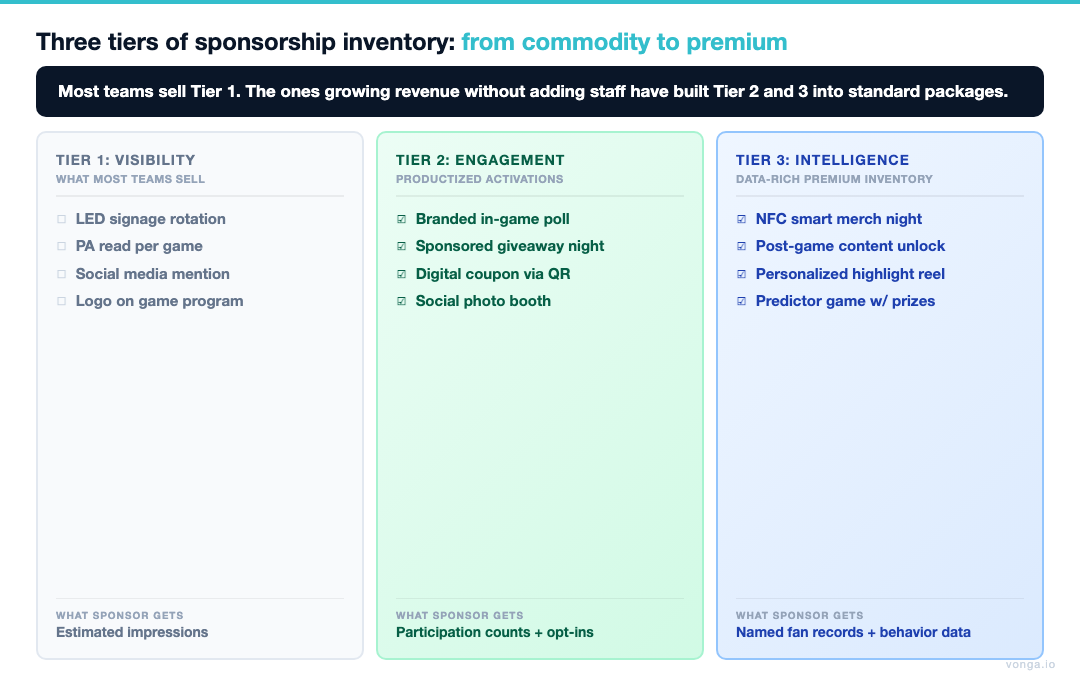
1. Productize Your Data Capture Assets Before You Sell Them
The Problem: Most teams build activations custom for each sponsor. This approach is relationship-appropriate but operationally unsustainable. Custom activations require custom buildouts, custom reporting, and custom troubleshooting across every partner.
The Strategy: Create two or three standardized "Fan Engagement Bundles" that can be sold off-the-shelf with defined deliverables, defined data outputs, and defined reporting formats. These bundles might include a digital sweep, a QR-triggered in-arena predictor game, and a post-game content unlock, combined into a named, tiered package.
Why It Works for Staff Efficiency: When the product is standardized, your sales team pitches faster, your activation team executes without reinvention, and your reporting team generates dashboards instead of custom decks.
Revenue Impact: Standardized packages enable faster sales cycles and cleaner renewals. Sponsors know what they're buying. Teams know what they're delivering. The conversation focuses on expansion rather than explanation.
When you give sponsors proof, not promises, with a product structure they can evaluate in advance, close rates improve and renewal conversations start from a higher baseline.
2. Turn Merchandise Into a Data Channel and Price It Accordingly
The Problem: Promotional merchandise giveaways such as t-shirt cannons, rally towels, and promo nights are budgeted as expenses. They generate brand impressions, not leads. They are not sellable as premium inventory because they produce no premium output.
The Strategy: Convert promotional merchandise into connected merchandise using NFC technology. When fans tap the item, they enter a sponsor-branded engagement funnel: exclusive content, discount codes, contest entries. Each tap captures an identified fan record.
Why It Works for Staff Efficiency: Connected merchandise runs itself. No staff required at point of engagement. Data flows into dashboards automatically. The initial setup is a one-time investment; ongoing execution is zero-labor.
Revenue Impact: Connected merchandise can be priced 3–5x higher than traditional promotional giveaways because the output is fundamentally different. A sponsor paying $5,000 for 1,000 branded t-shirts might pay $25,000 for 1,000 connected items that capture 150–400 identified leads.
3. Automate Post-Event Reporting With Real-Time Dashboards
The Problem: Post-event sponsor reports consume disproportionate staff time. Gathering data, formatting slides, and customizing recaps for each partner can take 2–4 hours per sponsor after every event. Across 30 sponsors and 40 home games, that is 2,400–4,800 staff hours annually.
The Strategy: Build or buy a reporting infrastructure that populates dashboards automatically. Sponsors log in to see their metrics in real time rather than waiting for a custom deck. Dashboards standardize output, reduce questions, and shift the team's role from data gatherer to strategic advisor.
Why It Works for Staff Efficiency: Automated reporting eliminates the most time-intensive post-event task. Staff hours shift from data compilation to relationship management and upselling.
Revenue Impact: Sponsors with real-time access to performance data renew faster and expand more often. Transparency builds trust. Trust accelerates the sales cycle.
4. Create a Tiered Inventory Model With Clear Upsell Paths
The Problem: Many teams sell sponsorships as custom packages negotiated from scratch. This creates variability in pricing, inconsistency in deliverables, and difficulty comparing sponsor performance across the portfolio.
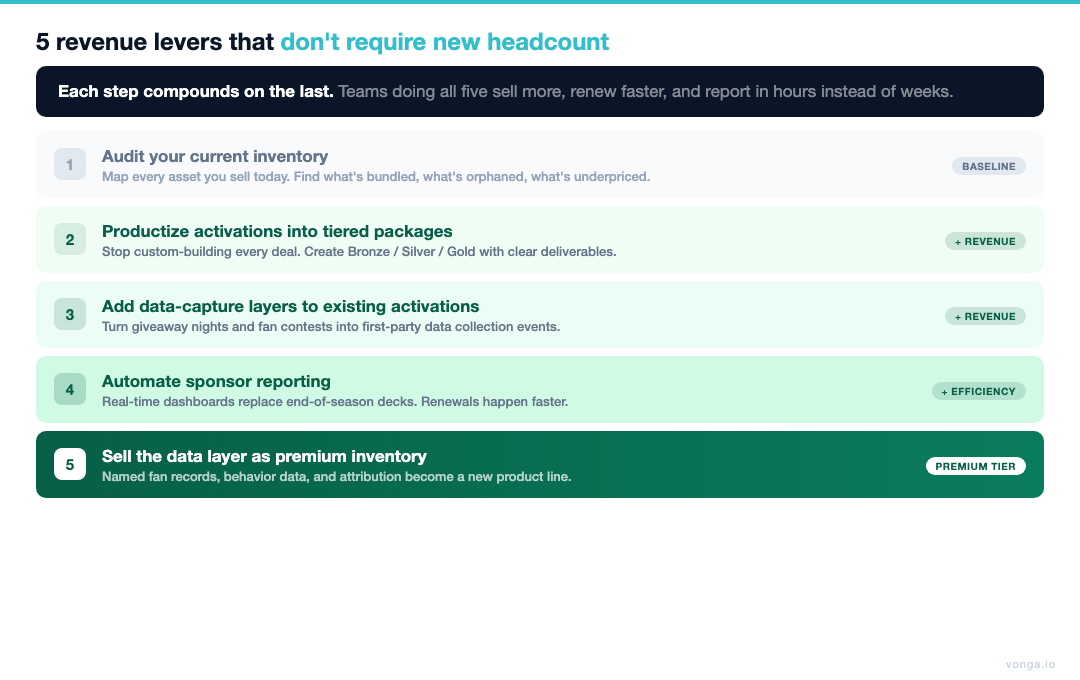
The Strategy: Build a tiered inventory model with named packages (e.g., "Starter," "Growth," "Premium") that include specific assets, specific data deliverables, and specific price points. Each tier includes a clear upsell path to the next level.
Why It Works for Staff Efficiency: Sales conversations become shorter. Sponsors self-select into tiers. Renewals become upsell conversations rather than renegotiations.
Revenue Impact: Tiered models with defined upsell paths increase average deal size over time. Sponsors who start at a lower tier have a visible path to expansion. The team's job shifts from selling to guiding.
5. Centralize Activation Execution Around Repeatable Formats
The Problem: Every sponsor wants something slightly different. Accommodating those requests creates execution sprawl: different tracking methods, different content formats, different fulfillment workflows. The customization tax compounds across the portfolio.
The Strategy: Define three to five activation formats that work across sponsor categories. A QR-triggered sweepstakes, an NFC-enabled giveaway, a post-game content unlock, a halftime prediction contest. Sponsors customize branding and prizes within those formats, not the format itself.
Why It Works for Staff Efficiency: Repeatable formats mean repeatable workflows. Staff execute the same process with different branding, rather than inventing new processes for each partner.
Revenue Impact: Execution efficiency means more activations can be sold. Sponsors who previously couldn't afford custom work can now participate in standardized formats at accessible price points. Portfolio breadth grows without portfolio complexity.
The Compounding Effect: How These Strategies Work Together
These five strategies are not isolated tactics. They compound.
- Productized data assets (#1) enable tiered inventory models (#4).
- Connected merchandise (#2) generates the data that feeds automated dashboards (#3).
- Centralized activation formats (#5) make productization (#1) possible.
The team that implements all five is not working 5x harder. They are working with a fundamentally different operating model, one where revenue grows while labor stays flat.
"The teams winning are not hiring. They are systematizing."
Implementation: Where to Start
If you're building from scratch, start with #3: automated reporting. Reporting is the most labor-intensive recurring task in most partnership departments. Automating it frees hours that can be reinvested in higher-value work.
If you already have reporting infrastructure, start with #1: productize your best activation. Take your most successful sponsor engagement format and turn it into a named, repeatable product with defined deliverables.
The goal is not to implement all five strategies in Q1. The goal is to shift the operating model over 12–18 months from custom/labor-intensive to standardized/scalable.
The Bottom Line
Growing sponsorship revenue without growing headcount is not about working harder. It is about working differently.
The five strategies above, productized data assets, connected merchandise, automated reporting, tiered inventory, and centralized formats, represent the operational shift that separates teams growing revenue per employee from teams burning out their staff.
The question is not whether to make this shift. It is how quickly.
Free Download: Digital Sponsorship Bundle Builder
Build tiered digital sponsorship packages that command premium pricing. This worksheet helps you structure scalable inventory.
Ready to build scalable sponsorship infrastructure? Let's talk →